

-
LOCATION:HOME >> NEWS >> Industry news
-
Industry news
Reading a Steel Quotation: MOQ, Coil Weight, Lead Time and Payment Terms
A steel quotation looks like a single number and behaves like a package of constraints; the price per tonne is the least informative part of it. What decides whether an order runs smoothly is the minimum quantity, the coil weight band, the tolerance class, the point from which lead time is counted and the payment split — and those five items are usually buried in the specification table rather than in the covering message.
An MOQ is a unit, not a threshold
The minimums published across this catalogue are stated in tonnes but constrained in coils. Hot-dip galvanized material is offered from 5 MT on the Z275 galvanized steel coil and Z350 grade range, and the same 5 MT applies to the light-gauge 0.4 mm and 26 gauge products. Since those coils run 3 to 5 t each, a 5 t order is one or two reels, and a buyer expecting a single coil at the minimum may find two reel numbers on the packing list and two handling charges on the invoice.
The spreads between families are wide. Cold-rolled sheet carries a 25 MT minimum on DC01, while duplex stainless coil starts at 1 ton — a ratio of 25 to 1 reflecting unit value and rolling campaign length rather than commercial preference. Electro-galvanized sheet is quoted against a minimum of 25 tons, one 20 ft FCL, and colour-coated coil from 1 ton on the prepainted coil range.
The hidden minimums are the ones that cause the arguments. A textured topcoat is quoted with a 15 t colour weight, so a four-colour facade in wrinkle PPGI is a 60 t programme or it accepts changeover cost. On the cold-rolled range, customised logo starts at 25 tons while customised packaging and graphic customisation both start at 50 tons. Branding a container is possible; branding a trial order is not.
The coil weight band fills the container before the tonnage does
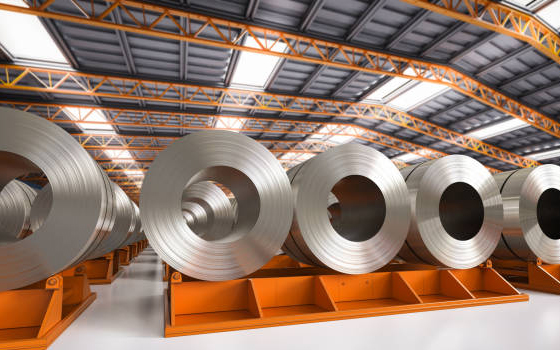
Weight per coil is specified in bands, not values: 3 to 5 t for much of the galvanized range, 3 to 8 t on DX51D+Z, 3 to 10 t on ST02Z and CS type B, 3 to 14 MT on DC01, and 3 to 20 t on PPGL. The container arithmetic then takes over. A 20 ft GP box measures 5898 by 2352 by 2393 mm and holds 24 to 26 CBM, which at 25 t is a full container of steel: five 5 t coils fill it, whereas the same tonnage in 3 t coils means eight or nine reels, more strapping and more end damage risk.
Inside diameter belongs in the same conversation because it is what the buyer's decoiler sees. The range is offered in 508 mm and 610 mm, and the JIS galvanized coil price carries a package weight of 2 to 6 t per coil, which suits lighter reels than a 20 t master coil will. Coil weight is also the cheapest lever on freight: heavier reels mean fewer lifts and lower handling cost per tonne, lighter reels easier processing on a small line. Ordering the band rather than the tonnage is what makes the quote reproducible.
Tolerance is bought, not assumed
Three different tolerance languages appear side by side. The galvanized range is quoted at 0.01 mm on thickness and 2 mm on width, the JIS cold-rolled galvanized product at plus or minus 0.02 mm, and cold-rolled sheet and stainless coil at plus or minus 1 percent. On a 0.5 mm sheet, one percent is five microns. A purchase order that asks for "industry standard tolerance" is asking for whichever of those three the seller prefers, and material cannot later be rejected against a class that was never specified.
Lead time has two clocks
Quoted lead times mix delivery from stock with delivery from the rolling schedule, and the wording usually says which. Galvanized coil is offered at 7 to 14 days after confirmed order, material drawn from stock at 1 to 15 days on Z60 industrial galvanized coil, and rolling-dependent product at 10 to 45 days after advance payment; DX54D+Z is quoted at 30 days after payment and 302 stainless plate at 15 to 25 days after deposit or letter of credit.
The important figure is the multiplier at volume. The DC01 page sets out a tiered schedule: 1 to 500 t in 7 days, 501 to 2,000 t in 10 days, 2,001 to 10,000 t in 20 days, and anything larger to be negotiated. Stainless behaves the same way: normal volume ships in 7 to 15 days, but 25 to 30 days once the order passes 1,000 t. A larger order buys a lower unit price and a longer wait; a project schedule that ignores the second half of that trade will miss its installation window.
Payment and price terms decide who holds the risk
The payment structures run from cash-against-documents to a split. The galvanized range lists T/T, L/C at sight, D/P and D/A; stainless is quoted at 30 percent T/T advance with 70 percent balance, and cold-rolled sheet to the same 30/70 split. Price terms are FOB, CFR, CIF or EXW, and the difference between FOB and CIF on steel is not only freight — under CIF the seller chooses the vessel and the stow, which decides whether coils arrive eye-to-sky in a dry box or as deck cargo. Both are legitimate; the buyer should know which one the quotation describes.
Capacity figures are a credibility signal, with limits
Published output is worth reading as an indicator rather than a guarantee: 40,000 MT per month on the galvanized line, 20,000 t per month on cold-rolled sheet, 10,000 MT per month on DX54D+Z, 5,000 t per month on 304 and 304L stainless coil and 4,500 t per month on 201 stainless. A capacity figure in the tens of thousands of tonnes tells a buyer that a 500 t order is a routine allocation rather than a favour, which is the practical question. It says nothing about the campaign schedule for a given coating mass or grade, which is what the order acknowledgement is for.
What to fix before the order is placed
Six items convert a quotation into an order that can be verified on arrival: minimum quantity stated in both tonnes and reels; coil weight band and inside diameter; tolerance class quoted as a number rather than a word; coating designation with the standard column named; the event from which lead time is counted; and the payment split with its price term. The supporting documents — standard and material designations such as ASTM A653 or JIS G3302, certificates to SGS, BV or ISO 9001, and the packing specification — should be attached to the purchase order rather than referred to by name. Where a specification has to be adjusted to a project, the customised product route and the galvanized, cold-rolled and hot-rolled catalogues carry the base ranges.