
-
LOCATION:HOME >> NEWS >> Industry news
-
Industry news
Ordering the Right Steel Form: Master Coil, Slit Strip, Cut-to-Length Sheet and Blanks
The form line on an enquiry — master coil, slit strip, cut-to-length sheet or blank — moves the price per tonne as much as the grade does. Every conversion between the mill's coil and the part you fabricate costs money, widens or tightens a tolerance, and puts the waste somewhere. What each form actually buys, what the equipment on both sides requires, and how to order the processing itself are set out below.
The form ladder
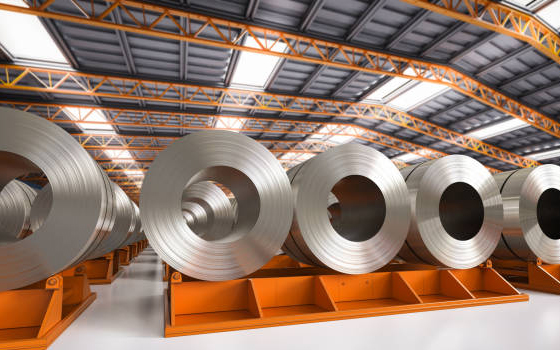
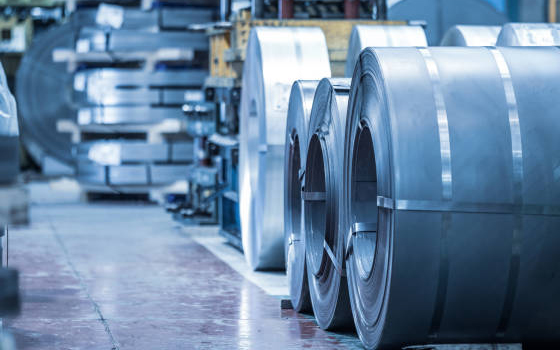
Steel leaves a flat-products mill as coil. Slitting divides the master width into narrower strips; cut-to-length shears the strip into flat sheets; blanking cuts sheets to a finished outline. Cost per tonne rises down that ladder, and yield improves when the widths match the parts instead of the mill's rolling table. Some of the range advertises the service openly: the ASTM and ASI cold-rolled coil page is named for its cutting and processing service, and the customised product menu lists steel cutting, shear, bending, punching, welding and surface treatment as orderable items. Processing can be bought with the material rather than after it, which is usually the cheaper way to buy it.
Start with the decoiler
Coil form is only cheaper if the receiving line can take it. Inside diameter across this catalogue is 508 or 610 mm, from the light-gauge 0.4 mm galvanized coil to PPGL, but the weights are not uniform: galvanized and galvalume reels run 3 to 5 t, painted coil is offered up to 20 t, and hot-rolled coil reaches 18 t on the SPHC page. A line built for 5 t reels cannot accept a 20 t master coil, and the buyer who orders master widths anyway pays for re-coiling before the first part is made. The 2 to 6 t package weight on the JIS galvanized line exists precisely for buyers with lighter handling.
Slitting: narrow widths and their edges
Slit strip is where the catalogue is wider than it looks. The JIS galvanized coil is offered from 30 mm to 1500 mm wide, and 430 stainless strip from 10 mm — both are slit-product widths, not master coil ones. DX51D+Z strip is specified at 3 to 10 t per coil, 508/610 mm ID and 200 to 550 N/mm² tensile, which is the form most press shops actually want. Width tolerance on the galvanized range is quoted at 2 mm and thickness at 0.01 mm — worth stating on the order, because a slit edge is where tolerance is created. Slit edges also carry burr and a work-hardened zone; feeding an exposed press tool with them costs more tool life than the slitting saved, unless the volumes are real.
Cut-to-length: length, flatness and the container
Sheet is ordered in lengths, and the pages say so plainly: ST02Z sheet is cut at thickness 0.19 to 2 mm, width 200 to 2500 mm, length to the customer's requirement; AZ120 galvalume sheet is offered 600 to 1250 mm wide or to buyer requirement. The practical ceiling is the box. A 20 ft GP container offers 5898 mm of internal length, so a 6 m blank does not ship in one; lengths beyond that move to a 40 ft box or break into two pieces and a weld. Flatness is the other specification: levelling happens at cut-to-length, and sheet that arrives wavy was cut from coil that was never levelled, so the standard to quote is a flatness class, not "flat".
Ordering the processing itself
The service pages read as a decision tree. Steel cutting distinguishes mechanical cutting for straight work under 10 mm, hydraulic shear above it, laser for precision and complex outlines, plasma for thick plate at speed, and waterjet where a heat-affected zone cannot be tolerated. Punching adds die punching for volume hole patterns and laser drilling for special shapes; bending covers knife bends, 180° and double-layer bends with bend-deduction formulas; welding is available as a line item. One caveat belongs on coated material: laser and plasma on galvanized or painted sheet fume the coating and burn back the cut edge, so vent the work and expect to touch up, or put the cut through the waterjet instead.
Yield, and who owns the offcut
Waste follows the form. A 1250 mm master coil slit into three 400 mm strips carries the kerf and trim losses of the slitter; the same coil cut to length in full width leaves the remnant to whoever bought the coil. Buying slit widths moves that waste upstream and often costs less per finished tonne despite the higher unit price on the narrower product. The corollary is to compare quotations in finished area, not tonnage, whenever the forms differ between suppliers — otherwise the comparison is between a coil and a part.
Minimums and the small-buyer path
Conversion raises minimums. Cold-rolled sheet carries a 25 t minimum on DC01, electro-galvanized SECCN2 is quoted at 25 tons, one 20 ft container, while cut ST02Z sheet starts at 5 t and stainless coil from 1 t on the duplex page. The stainless programme also prices customised packaging from 1,000 pieces, which is the small-lot route for buyers who need a branded form rather than a branded coil. Match the form to the minimum before negotiating the price; a form the supplier cannot run at your volume is not a price but a refusal.
What to put on the order
Form and dimensions with a tolerance class; decoiler ID and maximum reel weight; edge condition for strip; flatness class for sheet; packing note per form, because sheet packing and coil packing differ inside the same specification; and the processing steps the mill should complete before shipping. The processing product page shows the steps as a single menu, and the cold-rolled, hot-rolled and galvanized catalogues carry the base coils those steps start from. Order the form deliberately and the conversion cost becomes visible; order it casually and it reappears as someone's rework.